
Alter a (Fairly!) Fountain Pen Friendly Composition Notebook for Journaling
I published a post a few years ago, about how you can make two journals from one composition book. This past weekend, I quickly altered a full-size composition notebook that I bought at an office supply store for use as my daily journal with fountain pens, despite the fact that my absolute favorite paper for use with fountain pens is Clairefontaine. Why would I do that?? Is there such a thing as a fountain pen friendly notebook?
After all, fountain pen users are particular about our paper. I’m not a paper snob! I’m a fan of a lot of different papers. But, fountain pen ink tends to feather, bleed through and ghost on poor quality papers. Yet, I chose an everyday composition book to journal with. Well, a particular type of everyday composition book.
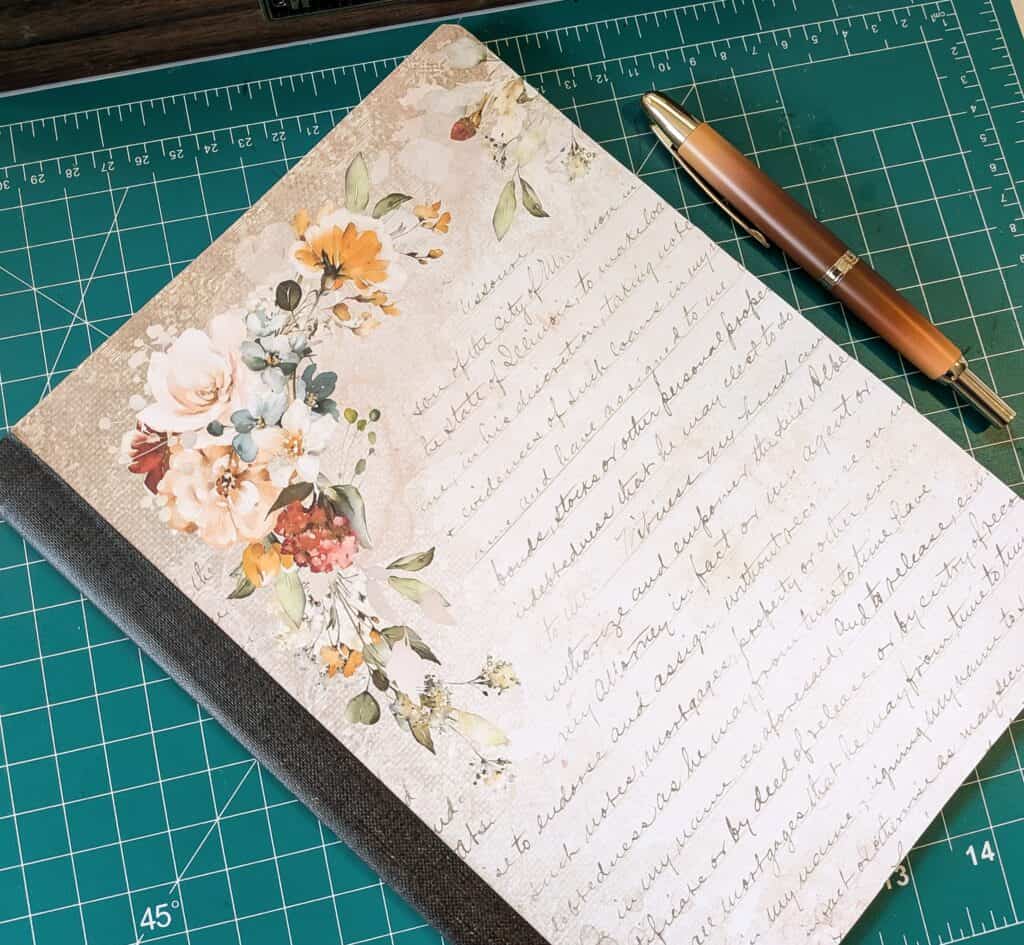
I’ll explain. Although I’ve used many different notebooks in the past, with several different fountain pen friendly papers, including Tomoe River, Rhodia, my favorite Clairefontaine, and this very inexpensive, gorgeous journal (which is surprisingly fountain pen friendly), I was filling those books pretty quickly. The words were spilling out of me at such a fast rate, I started thinking maybe I should consider less precious notebooks, at least for my daily journaling.
This post contains affiliate links which means I’ll earn a commission if you purchase through them, at no extra cost to you. As an Amazon affiliate, I earn from qualifying purchases.
I had been reading that composition books that are made in Vietnam or India often have nice paper in general and that it’s often fountain pen friendly paper. (This is probably not true for every single brand but true for some.) Classic Mead hardcover composition books are often mentioned in this category, as well as the Pen + Gear brand found at Walmart and the Brazic brand. It typically says where it was made on the back cover of the notebook.
I remembered that I had a couple of composition books tucked away in a drawer that I had bought at an office supply store during back to school time, so I pulled them out, and sure enough, they were made in Vietnam. So, I decided to give them a chance.
At the risk of being redundant – I already have the post about how I altered a composition book and made two journals from one book, as I mentioned – I thought I’d show you how I very quickly altered this full-size composition notebook to make it prettier and how fountain pen friendly the journal is. I know the quality of the paper is a big factor in the joy of journaling with fountain pens (or any pens, really), and although this one isn’t at the higher end of fountain pen friendly paper, it’s surprisingly good and fun to use.
And, even if you don’t use fountain pens, consider altering one of these old school notebooks for a simple, pretty journal!
I gave the paper in my notebook a test. It’s not bad at all. No feathering and, although there is a little bit of ghosting and also some bleed-through with a few of my very wet inks, that aspect is surprisingly good, too. (I use primarily fine nibs, so if you use medium nibs or wider, bleed-through could be a bigger issue for you. But, maybe not, depending on the ink.)
Here are examples of how some of my fountain pens perform in this notebook (fine nibs.) These Jinhao nibs are a bit wider than the nibs on my better quality Pilot pens, but they still performed pretty well, with regard to ghosting and bleed-through.
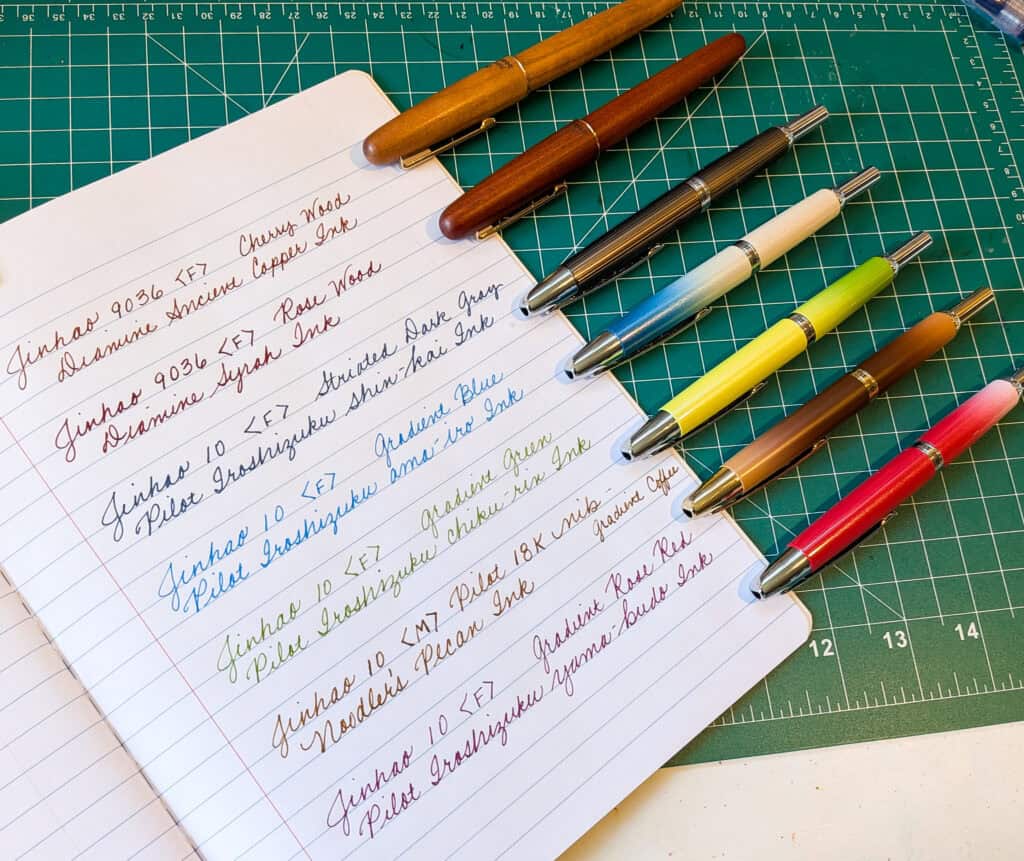
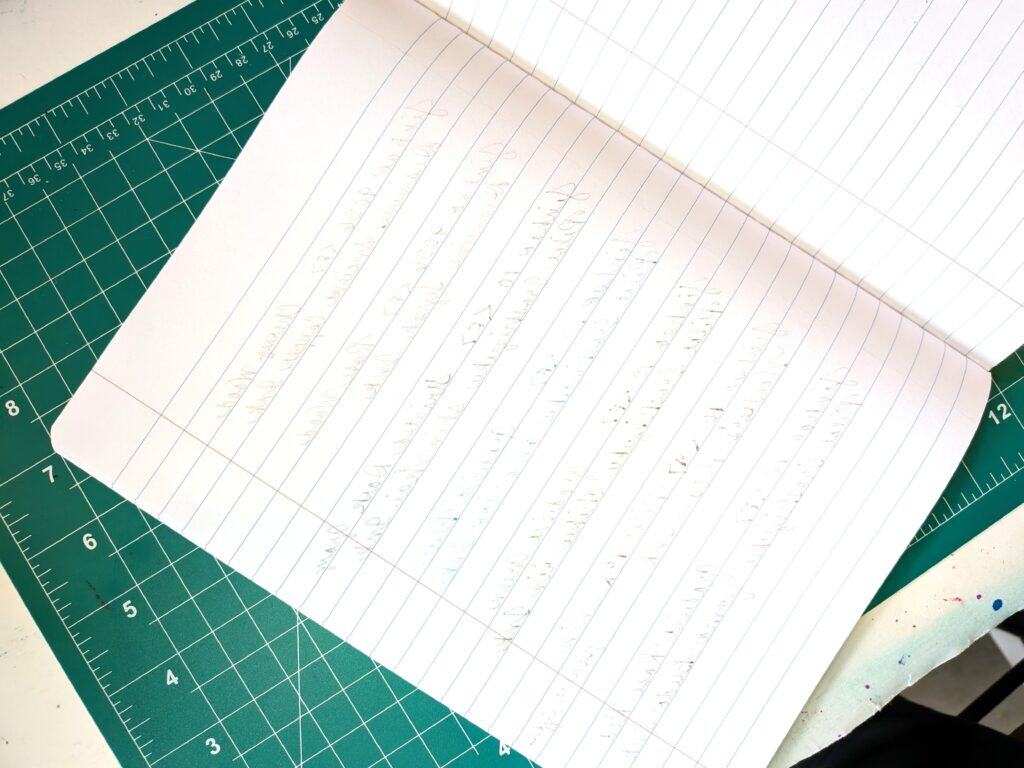
As you can see in the picture above, there is some ghosting. Not too terrible, though. (I use mostly fine nibs, so I’m not sure this would be the best fit for broader nibs or flex nibs or really wet inks.) Update: I ordered this Mead Composition Book, as well as a Brazic one, and they arrived right after I wrote this post. The Mead performs even better than the one I used. The Brazic was better than the one I used, but the Mead was the clear winner. Less ghosting and smoother paper. I ordered the Mead notebook in wide ruled, but it also comes in college ruled. I’ll be buying more of the Mead notebooks!

If I want to use more broad nibs or flex nibs or wetter inks, I can always just adhere two pages together or maybe just not write on the back, if there’s too much ghosting.
Now, I do still do a lot of writing in my higher quality notebooks. I write verses, quotes, gratitude, etc. in those. And for me, nothing beats the beauty and quality of Clairefontaine paper.
But for my daily thought dumping, I’ve been using this altered one. I love how pretty it is and how much room I have on the pages. There is also a freedom I feel when writing in this notebook. It’s such an inexpensive book, which is less intimidating to me. Sometimes I’m frozen by beautiful, expensive journals. With this one, I just write and write.
How to Alter the Covers of a Fountain Pen-Friendly Composition Book
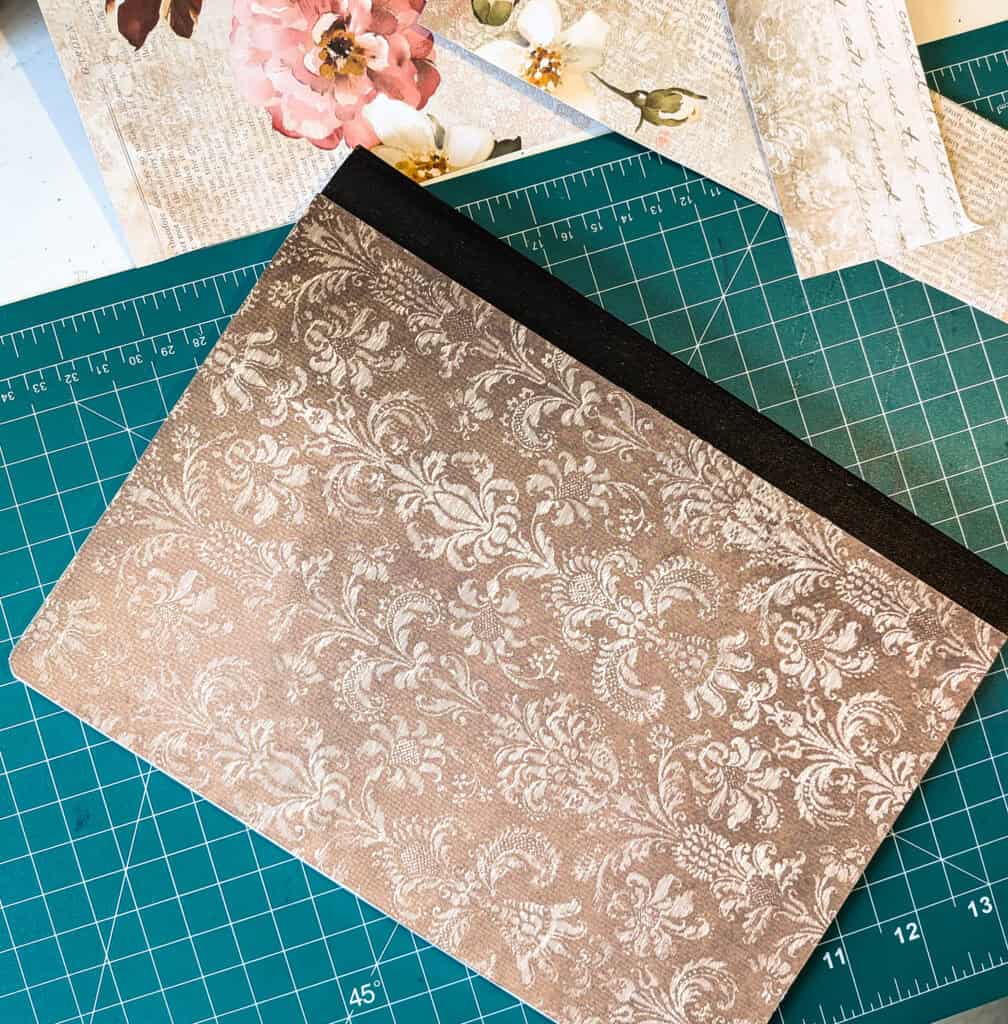
It almost feels ridiculous of me to call this a tutorial, given that it literally took me about 5 minutes to do. And really, all I did was just cover the front and back to make it prettier. I had the tools and pretty paper on hand, so it was a breeze.
Tools Needed
- A fountain pen-friendly composition notebook Classic Mead hardcover composition books, Pen+ Gear compostion books, and Bazic composition are a few that are frequently mentioned as having better quality paper, if they are made in Vietnam or India. I haven’t tried the Pen+Gear brand, but between the others I mentioned, Mead performed the best for me.
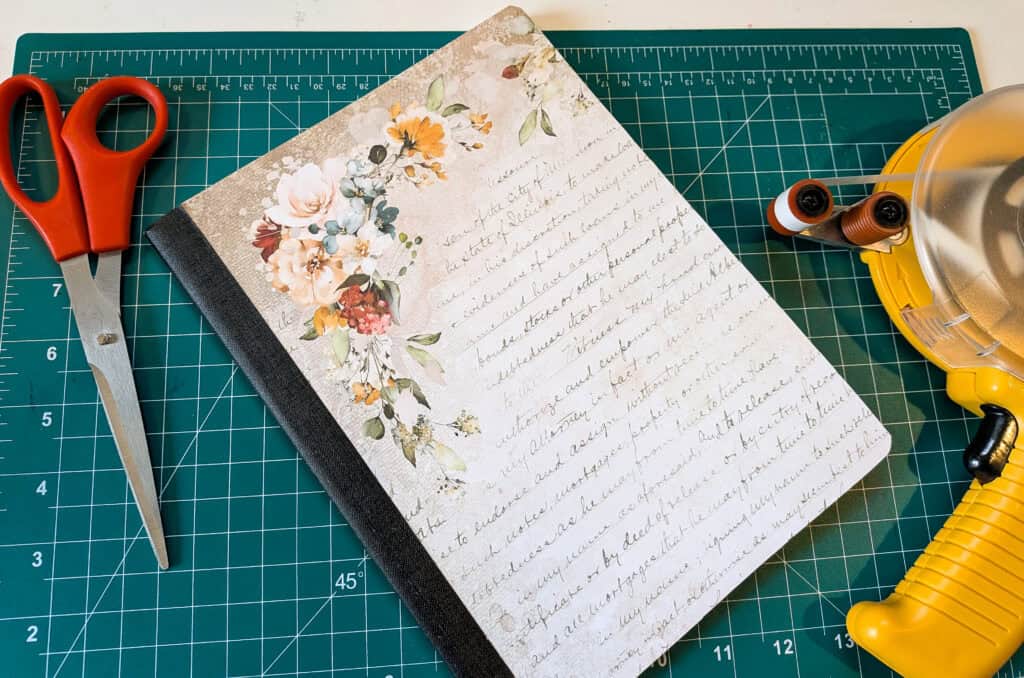
- Decorative paper I used a scrapbook paper that I had on hand. It’s one of my favorites. I haven’t done any scrapbooking in years, but I still have a lot of pretty paper. The one I’ve linked to is a little pricey but really lovely. Paper that is thick enough that the cover doesn’t show through will work. Even a thick gift wrap would work.
- Scissors
- Paper adhesive Any non-wrinkling glue should work. For ease of use and for strength of adhesion, my favorite tool is my Scotch ATG Adhesive Applicator. I bought mine years ago, and I believe there are newer versions. It’s a little pricey (and, as I understand it, it doesn’t come with the tape. That has to be purchased separately.) But, if you do a lot of creating with paper or make little books, framing, etc., it’s a wonderful tool. The tape is strong, so be pretty sure where you want the paper because you might not be able to move it!
How I Made It
- First, I laid down some strips of double sided tape from my Scotch ATG applicator onto the front of the notebook. I didn’t skimp here. I laid down several strips of tape. (You could also use a non-wrinkling paper glue or non-wrinkling craft glue or double sided tape you have on hand. I always prefer the tape because it’s less messy!)
- I literally then just butted the piece of decorative paper up against the tape binding on the front of the cover and pressed it down firmly onto the tape. Then I cut off the excess around the edge of the notebook.
- I repeated the process on the back cover. That’s it.
- At this point, you can also cover the inside covers. I didn’t! I kind of like the quirkiness of the class schedule, metric conversions, etc. on the inside covers.
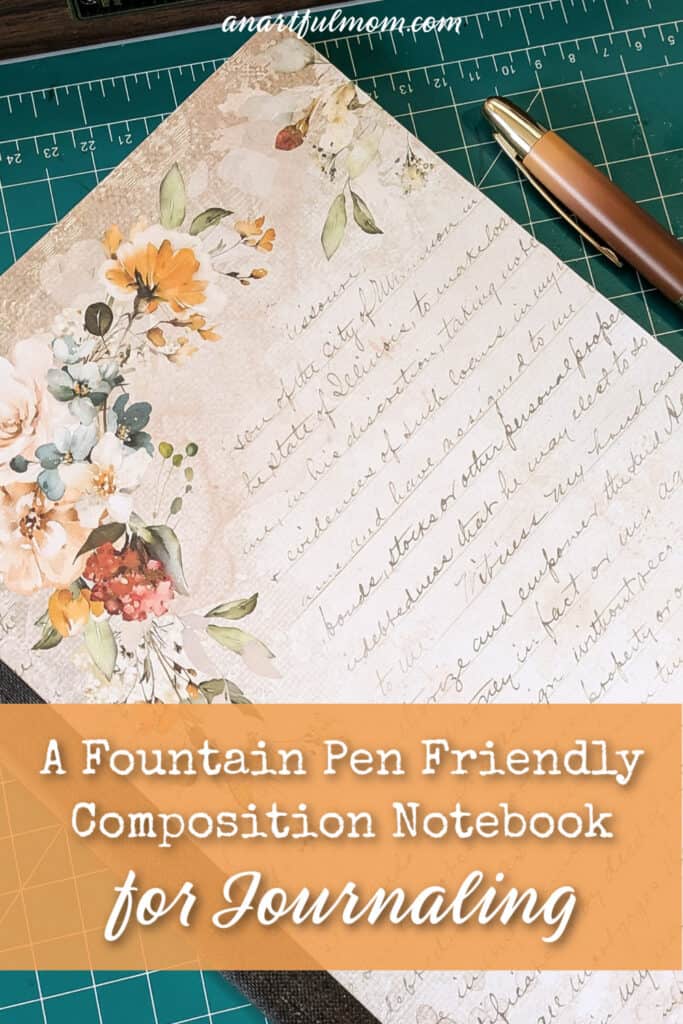
Have you found some brands of composition books that have worked well with your fountain pens and inks? If so, please share!
Linking to:
Lou Lou Girls, Jenerally Informed, Sum of Their Stories, Wonderful Wednesday, Thursday Favorite Things, Creatively Crafty, French Ethereal, Try It Like It, The Answer is Chocolate, The Cottage Market, Shabby Art Boutique, Funtastic Friday, Farmhouse Friday, Crazy Little Lovebirds, Life and Linda, Sew Can Do, A Pinch of Joy, Senior Salon Pit Stop, Keeping it Real, Mostly Blogging, Wednesdays in the Studio, Funtastic Friday



I had a lot of clients that used fountain pens. I love the look and also the nicer paper they opted for. I’m a leftie so no…or at least I’m not skilled enough to manage it! #Happynow
Thanks for reading, Lydia! There are definitely adjustments necessary for lefties with fountain pens!
I love a good pen! I haven’t found one that is a favorite yet, so thanks for the recommendations.
Same! And, I will definitely be buying more of the Mead composition books. It’s the little things! 🙂
Your journal looks beautiful with its new cover! I am in my 70s, and when I was young penmanship was considered a very important skill and we were required to use a fountain pen to write. When ball point pens became popular they seemed so easy to use. Now I prefer a felt tip pen,
Thank you, Pat! I’m enjoying it so much. Penmanship was important as I was growing up, too. I love beautiful handwriting so much.
I used to let the kids at school make their reading journals like this. So fun!
That’s awesome, Susan! Great idea!